
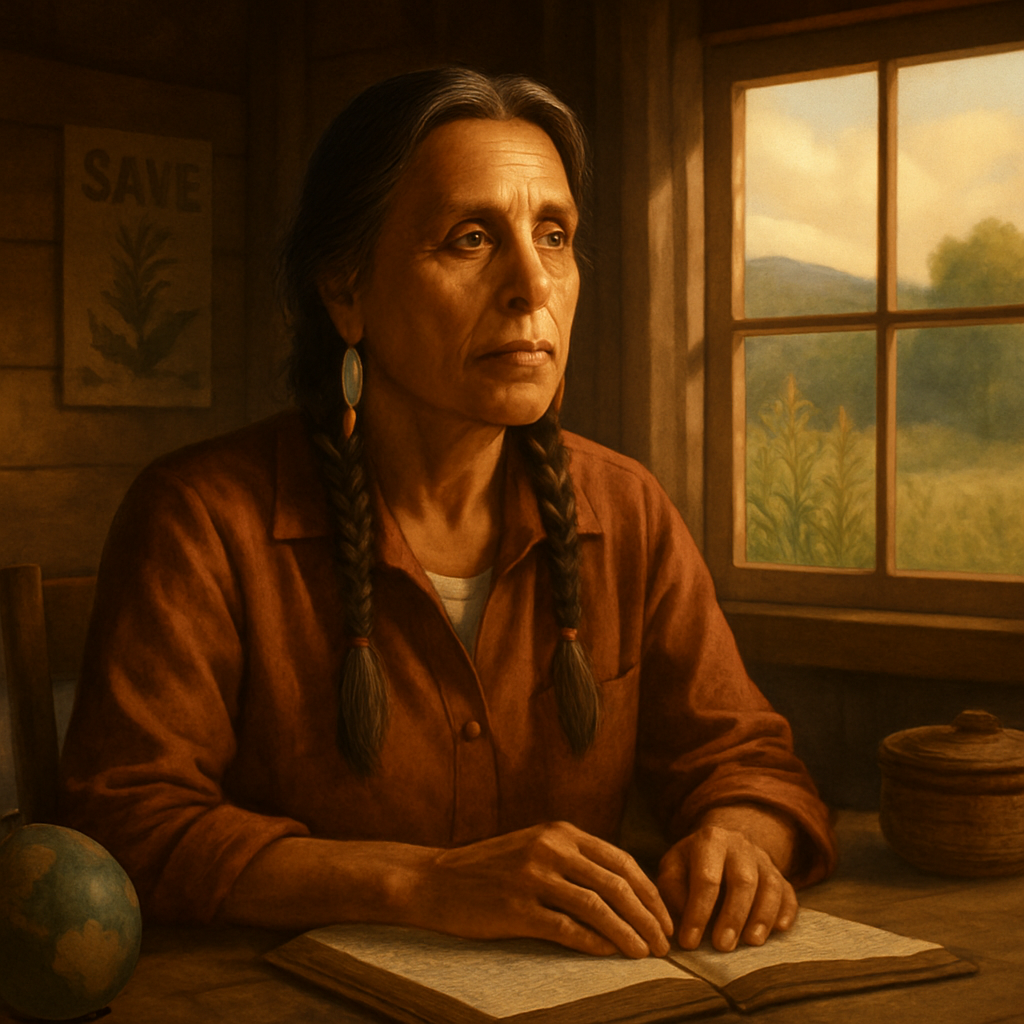
Winona LaDuke
Links land, food, women, treaties, energy, and sovereignty into a living politics of repair.
Life and thought
Connects land back, food sovereignty, Indigenous economics, feminism, ecology, treaties, and resistance to extractive systems.
Winona LaDuke is presented in the Thought archive through environmental thought, anishinaabe / native american, anishinaabe / united states, contemporary. The recorded life dates are 1959–present. The profile connects this work to Ecology, Feminist Thought, Indigenous Thought, Political Philosophy.
The central questions gathered here concern land back, food sovereignty, treaty rights, extractivism, Indigenous feminism. Together they show the recurring problems, methods, and distinctions that define this thinker’s contribution.
Winona LaDuke developed within an intellectual conversation shaped by Anishinaabe traditions, Native activism, environmental justice. These names provide context for the traditions and problems surrounding the work; they do not imply simple agreement.
The surviving reading path begins with All Our Relations, Recovering the Sacred, The Militarization of Indian Country. The recorded legacy extends toward Indigenous environmentalism, food sovereignty, climate justice.
Five Defining Theories
The central ideas, methods, and arguments that give this thinker’s work its distinctive shape.
land back
A central idea in this thinker’s work, method, and intellectual legacy.
food sovereignty
A central idea in this thinker’s work, method, and intellectual legacy.
treaty rights
A central idea in this thinker’s work, method, and intellectual legacy.
extractivism
A central idea in this thinker’s work, method, and intellectual legacy.
Indigenous feminism
A central idea in this thinker’s work, method, and intellectual legacy.
Life journey
A structured path through the verified context attached to this profile.
Context
1959–present · Anishinaabe / United States · Contemporary
Intellectual formation
The recorded influences include Anishinaabe traditions, Native activism, environmental justice.
Defining ideas
The profile centres on land back, food sovereignty, treaty rights, extractivism, Indigenous feminism.
The work
A reading path through All Our Relations, Recovering the Sacred, The Militarization of Indian Country.
Lasting influence
The recorded influence reaches Indigenous environmentalism, food sovereignty, climate justice.
In time
Major Works
Texts through which the thinker’s ideas entered the wider intellectual record.
All Our Relations
This work matters because it carries a central part of the thinker’s method, argument, or intellectual legacy into a form readers can examine directly.
Recovering the Sacred
This work matters because it carries a central part of the thinker’s method, argument, or intellectual legacy into a form readers can examine directly.
The Militarization of Indian Country
This work matters because it carries a central part of the thinker’s method, argument, or intellectual legacy into a form readers can examine directly.
Influence network
Trace the intellectual lineage into and beyond this thinker.
Selected quotations
The recovery of the people is tied to recovery of food.
Power is in the earth.
You cannot buy your way into sustainability.
We need to recover the sacred.
A society based on conquest cannot be sustained.
Schools of thought
Ecology
Explore the thinkers and ideas connected to this tradition.
Explore school F68 thinkersFeminist Thought
Explore the thinkers and ideas connected to this tradition.
Explore school I20 thinkersIndigenous Thought
Explore the thinkers and ideas connected to this tradition.
Explore school P185 thinkersPolitical Philosophy
Explore the thinkers and ideas connected to this tradition.
Explore schoolConnected Thinkers
Clara Zetkin
SharedFeminist Thought · Political Philosophy
View thinker →
Rosa Luxemburg
SharedFeminist Thought · Political Philosophy
View thinker →
Kimberlé Crenshaw
SharedFeminist Thought · Contemporary
View thinker →
Patricia Hill Collins
SharedFeminist Thought · Contemporary
View thinker →
Jan Christiaan Smuts
SharedPolitical Philosophy
View thinker →
Pierre Bourdieu
SharedPolitical Philosophy
View thinker →Featured Debates
See how Winona LaDuke’s perspective changes when it meets another mind.



Is Sovereignty a Barrier to Global Justice in Conflict Regions?
In an era where global conflicts challenge traditional notions of state sovereignty, the question arises: does the principle of sovereignty obstruct the path to global justice?…
View Debate →

Can Sovereignty Respect Human Rights Without Undermining National Security?
In a world increasingly defined by complex geopolitical tensions and the quest for human dignity, the question arises: Can a nation maintain its sovereignty while respecting…
View Debate →

The Legitimacy of Punishment and the Absurdity of Justice
The Legitimacy of Punishment and the Absurdity of Justice
View Debate →

The Perils of Uncritical Acceptance of Technological Advancements
The Perils of Uncritical Acceptance of Technological Advancements
View Debate →Continue the conversation with Winona LaDuke.
Test an assumption, explore an idea, or bring this perspective into dialogue with a council of other thinkers.