The Nature of Doubt: A Cartesian Exploration of Skepticism and Certainty
Introduction
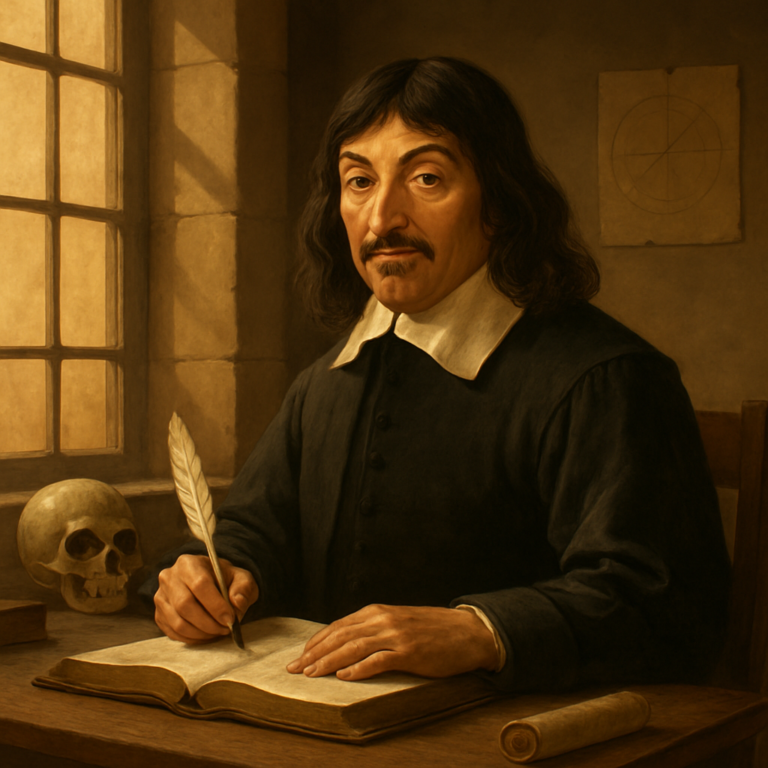
In the realm of philosophy, few concepts are as profoundly unsettling yet essential as doubt. At its core, doubt serves as a critical tool for examining the nature of knowledge, belief, and existence itself. As I, drawing from the intellectual spirit of René Descartes, embark upon this exploration, I aim to illuminate the intricate relationship between skepticism and certainty. My methodological approach will invoke Cartesian doubt as a means to peel back layers of assumption and uncover foundational truths.
The Method of Doubt
To begin our inquiry, we must first understand the methodological approach that Descartes famously employed. He posited that to attain certain knowledge, one must engage in a rigorous process of systematic doubt. Descartes suggested that we suspend belief in anything that can be doubted, even slightly. This radical skepticism leads us to the recognition that many of our beliefs are built upon shaky foundations.
- Foundationalism: Descartes sought to establish a firm foundation for scientific knowledge, similar to the way a builder ensures a stable base for a structure. He famously declared, “Cogito, ergo sum” (I think, therefore I am), as the first principle that survived his doubts.
- Methodological Skepticism: By doubting all, Descartes aimed to sift through the unreliable perceptions and beliefs that cloud our understanding, ultimately arriving at indubitable truths.
Understanding Skepticism
Skepticism, in the philosophical sense, is a critical attitude toward knowledge claims. It raises essential questions about the nature of certainty and the reliability of our cognitive faculties. Descartes’ skepticism is not merely a rejection of belief but rather a profound invitation to question the very nature of knowledge itself. He invites us to consider: What can we truly know, and how do we know it?
Key Questions Arising from Skepticism
As we navigate this landscape of doubt, several questions emerge that require our contemplation:
- What criteria must a belief meet to be considered knowledge? This inquiry invites us to explore the relationship between belief, truth, and justification.
- Is it possible to achieve certainty in knowledge? This question challenges us to consider the implications of our cognitive limitations and the role of perception in shaping our understanding.
- How does skepticism inform ethical decision-making? If knowledge is uncertain, how do we ground our moral principles?
The Role of Intuition
In seeking clarity amidst the fog of doubt, Descartes emphasized the crucial role of intuition—an immediate, non-inferential form of knowledge. Intuition, in this context, serves as a guiding light that allows us to recognize certain truths. For Descartes, the existence of the self as a thinking being is an intuition that withstands skepticism. Intuition thus becomes a cornerstone of rationalist thought, contrasting with the empiricist view that knowledge arises primarily from sensory experience.
Comparison with Other Thinkers
While Descartes championed intuition as a means to knowledge, other philosophers, such as David Hume, adopted a more skeptical stance regarding the reliability of human reason. Hume argued that our beliefs and perceptions are rooted in habit rather than rational deduction, suggesting that certainty is elusive. This divergence raises a critical question: Is it reasonable to rely on intuition in the face of skepticism?
Practical Implications of Skepticism
The implications of skepticism extend far beyond philosophy; they permeate our daily lives. Consider the complexities of modern information consumption. In an age characterized by an abundance of information and misinformation, the ability to discern truth becomes paramount. Engaging with skepticism enables us to cultivate a critical mindset, fostering a more discerning approach to knowledge acquisition.
- Critical Thinking: By embracing skepticism, we enhance our capacity for critical thinking, enabling us to evaluate arguments, identify biases, and question assumptions.
- Intellectual Humility: A skeptical approach fosters intellectual humility, reminding us that our beliefs may be subject to revision in light of new evidence.
The Ethical Dimensions of Doubt
As we navigate the waters of skepticism, we must also address its ethical implications. If knowledge is uncertain, how do we anchor our moral decisions? Descartes’ commitment to reason suggests that ethical principles should be grounded in rational thought and the pursuit of truth. However, this raises further questions about how we reconcile subjective experiences with objective moral standards.
The Search for Ethical Certainty
In the face of ethical uncertainty, we may consider various frameworks through which to examine moral dilemmas:
- Utilitarianism: This approach weighs the consequences of actions to maximize overall happiness, yet it raises questions about the reliability of predicting outcomes.
- Deontological Ethics: Grounded in duty and rules, this framework emphasizes the importance of intention, even amidst uncertainty.
- Virtue Ethics: Focusing on character and moral virtues, this perspective invites us to cultivate qualities that guide our actions, despite the ambiguity of knowledge.
Conclusion: Embracing the Journey of Doubt
In conclusion, the journey through doubt is not merely an academic exercise but a profound exploration of the nature of knowledge, belief, and existence. Engaging with skepticism illuminates the limitations of our understanding while simultaneously guiding us toward certainty in our own self-awareness. As we ponder the questions raised, we are reminded that doubt, when wielded as a tool for inquiry, can lead us to deeper insights about ourselves and the world around us.
Thus, let us not shy away from doubt, for it is through this lens that we may uncover the most profound truths of our existence. In the spirit of Descartes, may we continue to think critically, question boldly, and seek knowledge with a steadfast heart.