
Bertrand Russell
Helped found analytic philosophy and clarified logic, mathematics, skepticism, ethics, and public debate.
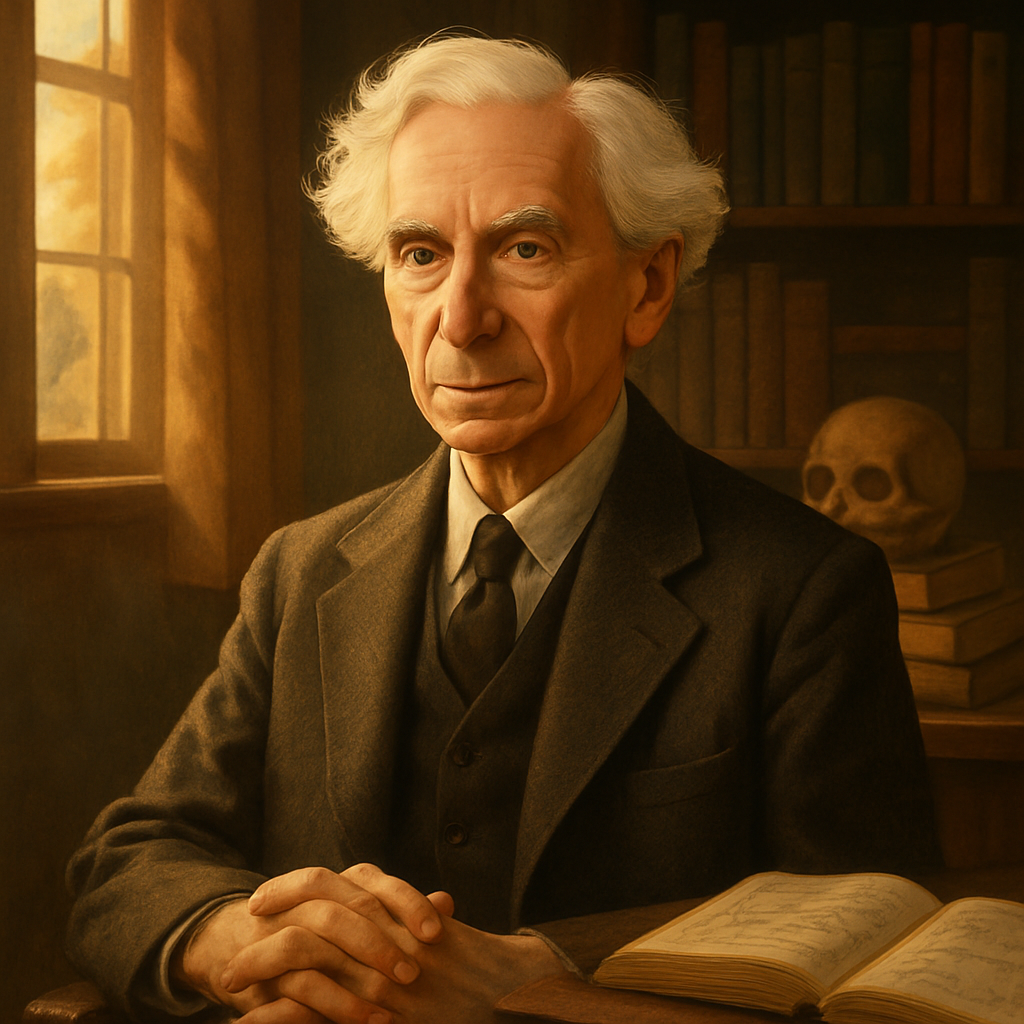
Life and thought
Clarifies logic, language, mathematics, skepticism, ethics, peace, and public reason with analytical precision.
Bertrand Russell is presented in the Thought archive through philosophy, british, britain, modern. The recorded life dates are 1872–1970. The profile connects this work to Language & Meaning, Logic, Mathematics, Western Philosophy.
The central questions gathered here concern logical atomism, analytic philosophy, types, skepticism, public reason. Together they show the recurring problems, methods, and distinctions that define this thinker’s contribution.
Bertrand Russell developed within an intellectual conversation shaped by Leibniz, Frege, Peano, Hume. These names provide context for the traditions and problems surrounding the work; they do not imply simple agreement.
The surviving reading path begins with Principia Mathematica, Problems of Philosophy, History of Western Philosophy, Why I Am Not a Christian. The recorded legacy extends toward Wittgenstein, analytic philosophy, logic, public intellectual culture.
Five Defining Theories
The central ideas, methods, and arguments that give this thinker’s work its distinctive shape.
logical atomism
A central idea in this thinker’s work, method, and intellectual legacy.
analytic philosophy
A central idea in this thinker’s work, method, and intellectual legacy.
types
A central idea in this thinker’s work, method, and intellectual legacy.
skepticism
A central idea in this thinker’s work, method, and intellectual legacy.
public reason
A central idea in this thinker’s work, method, and intellectual legacy.
Life journey
A structured path through the verified context attached to this profile.
Context
1872–1970 · Britain · Modern
Intellectual formation
The recorded influences include Leibniz, Frege, Peano, Hume.
Defining ideas
The profile centres on logical atomism, analytic philosophy, types, skepticism, public reason.
The work
A reading path through Principia Mathematica, Problems of Philosophy, History of Western Philosophy, Why I Am Not a Christian.
Lasting influence
The recorded influence reaches Wittgenstein, analytic philosophy, logic, public intellectual culture.
In time
Major Works
Texts through which the thinker’s ideas entered the wider intellectual record.
Principia Mathematica
This work matters because it carries a central part of the thinker’s method, argument, or intellectual legacy into a form readers can examine directly.
Problems of Philosophy
This work matters because it carries a central part of the thinker’s method, argument, or intellectual legacy into a form readers can examine directly.
History of Western Philosophy
This work matters because it carries a central part of the thinker’s method, argument, or intellectual legacy into a form readers can examine directly.
Why I Am Not a Christian
This work matters because it carries a central part of the thinker’s method, argument, or intellectual legacy into a form readers can examine directly.
Influence network
Trace the intellectual lineage into and beyond this thinker.
Selected quotations
The good life is inspired by love and guided by knowledge.
To conquer fear is the beginning of wisdom.
The trouble with the world is that the stupid are cocksure.
Do not fear to be eccentric in opinion.
Science is what you know; philosophy is what you do not know.
Schools of thought
Language & Meaning
Explore the thinkers and ideas connected to this tradition.
Explore school L29 thinkersLogic
Explore the thinkers and ideas connected to this tradition.
Explore school M49 thinkersMathematics
Explore the thinkers and ideas connected to this tradition.
Explore school W91 thinkersWestern Philosophy
Explore the thinkers and ideas connected to this tradition.
Explore schoolConnected Thinkers
Georg Cantor
SharedLogic · Mathematics · Modern
View thinker →
David Hilbert
SharedLogic · Mathematics · Modern
View thinker →
Leonhard Euler
SharedLogic · Mathematics
View thinker →
Henri Poincaré
SharedMathematics · Modern
View thinker →
Benoit Mandelbrot
SharedMathematics · Modern
View thinker →
Carl Friedrich Gauss
SharedMathematics · Modern
View thinker →Featured Debates
See how Bertrand Russell’s perspective changes when it meets another mind.



Does Military Intervention Ever Truly Secure Lasting Peace?
The question of whether military intervention can ever truly secure lasting peace has long been a contentious issue. In this debate, Judah Magnes, a proponent of…
View Debate →

The Moral and Ethical Limits of Sovereignty in Modern Warfare
The Moral and Ethical Limits of Sovereignty in Modern Warfare
View Debate →

The Role of Reason and Revelation in Preventing Technological Misuse
With rapid technological advancements challenging ethical and societal frameworks, it is crucial to examine how reason and revelation can guide wise governance and prevent potential abuses.…
View Debate →

Balancing Privacy Rights and Public Health Data Sharing in Global Health Crises
In an increasingly interconnected world, the tension between individual privacy rights and the necessity for data sharing in public health emergencies is a critical issue. As…
View Debate →Continue the conversation with Bertrand Russell.
Test an assumption, explore an idea, or bring this perspective into dialogue with a council of other thinkers.