
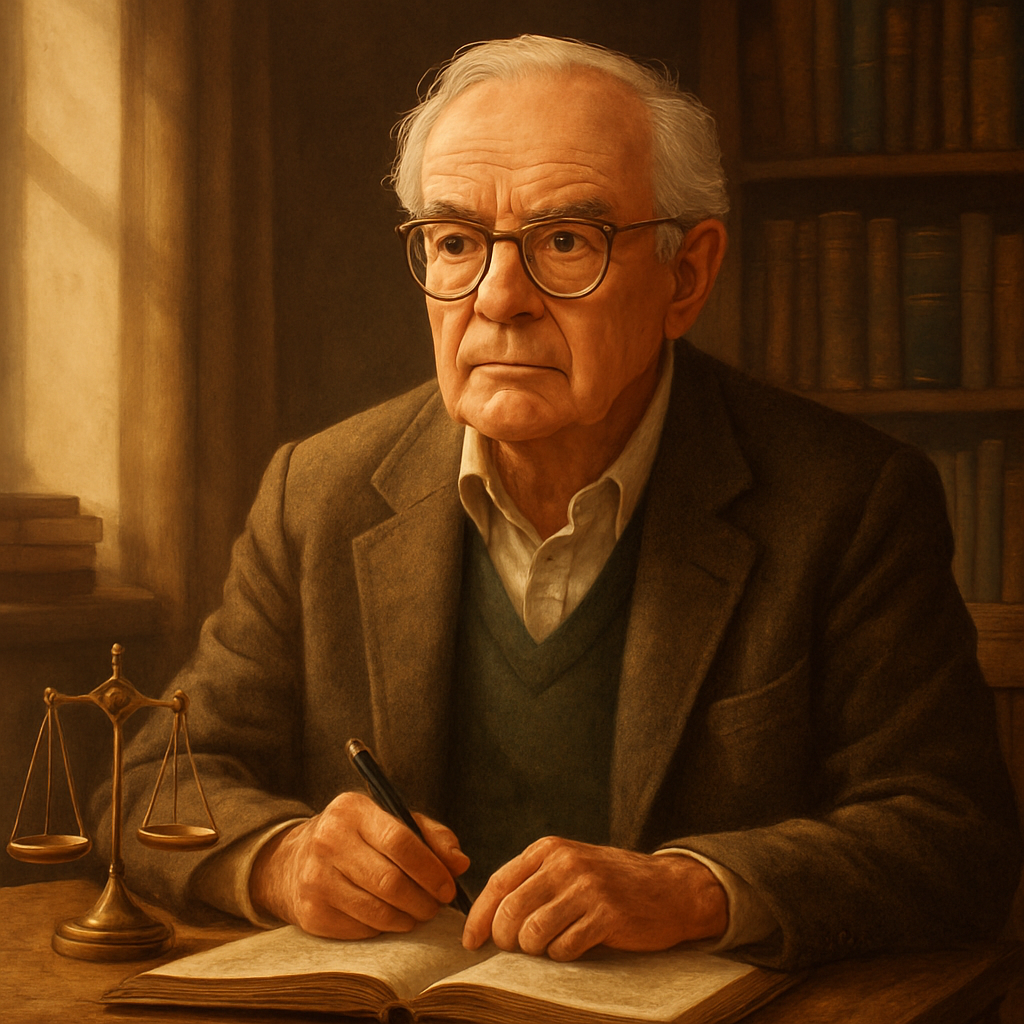
Alasdair MacIntyre
Philosopher of virtue, tradition, practices, and moral fragmentation.
Life and thought
Argues that modern moral argument is fragmented without traditions of virtue and shared practices.
Alasdair MacIntyre is presented in the Thought archive through philosophy, scottish / american, scottish / american, contemporary. The recorded life dates are 1929–present. The profile connects this work to Ethics, Political Philosophy, Religion & Mysticism, Virtue Ethics.
The central questions gathered here concern virtue ethics, tradition, practices, narrative unity, moral fragmentation. Together they show the recurring problems, methods, and distinctions that define this thinker’s contribution.
Alasdair MacIntyre developed within an intellectual conversation shaped by Aristotle, Aquinas, Marx. These names provide context for the traditions and problems surrounding the work; they do not imply simple agreement.
The surviving reading path begins with After Virtue, Whose Justice? Which Rationality?, Dependent Rational Animals. The recorded legacy extends toward virtue ethics revival, communitarian thought, theology.
Five Defining Theories
The central ideas, methods, and arguments that give this thinker’s work its distinctive shape.
virtue ethics
A central idea in this thinker’s work, method, and intellectual legacy.
tradition
A central idea in this thinker’s work, method, and intellectual legacy.
practices
A central idea in this thinker’s work, method, and intellectual legacy.
narrative unity
A central idea in this thinker’s work, method, and intellectual legacy.
moral fragmentation
A central idea in this thinker’s work, method, and intellectual legacy.
Life journey
A structured path through the verified context attached to this profile.
Context
1929–present · Scottish / American · Contemporary
Intellectual formation
The recorded influences include Aristotle, Aquinas, Marx.
Defining ideas
The profile centres on virtue ethics, tradition, practices, narrative unity, moral fragmentation.
The work
A reading path through After Virtue, Whose Justice? Which Rationality?, Dependent Rational Animals.
Lasting influence
The recorded influence reaches virtue ethics revival, communitarian thought, theology.
In time
Major Works
Texts through which the thinker’s ideas entered the wider intellectual record.
After Virtue
This work matters because it carries a central part of the thinker’s method, argument, or intellectual legacy into a form readers can examine directly.
Whose Justice? Which Rationality?
This work matters because it carries a central part of the thinker’s method, argument, or intellectual legacy into a form readers can examine directly.
Dependent Rational Animals
This work matters because it carries a central part of the thinker’s method, argument, or intellectual legacy into a form readers can examine directly.
Influence network
Trace the intellectual lineage into and beyond this thinker.
Selected quotations
Virtue ethics must be examined, not inherited.
Power becomes dangerous when it forgets dignity.
A society reveals itself by what it teaches people to notice.
Freedom without responsibility becomes another form of blindness.
The hardest questions are usually the most human ones.
Schools of thought
Ethics
Explore the thinkers and ideas connected to this tradition.
Explore school P185 thinkersPolitical Philosophy
Explore the thinkers and ideas connected to this tradition.
Explore school R84 thinkersReligion & Mysticism
Explore the thinkers and ideas connected to this tradition.
Explore school V3 thinkersVirtue Ethics
Explore the thinkers and ideas connected to this tradition.
Explore schoolConnected Thinkers
Frederick Douglass
SharedEthics · Political Philosophy
View thinker →
Sojourner Truth
SharedEthics · Religion & Mysticism
View thinker →
Émile Durkheim
SharedEthics · Religion & Mysticism
View thinker →
Max Weber
SharedPolitical Philosophy · Religion & Mysticism
View thinker →
Jan Christiaan Smuts
SharedPolitical Philosophy · Philosophy
View thinker →
Patricia Hill Collins
SharedEthics · Contemporary
View thinker →Featured Debates
See how Alasdair MacIntyre’s perspective changes when it meets another mind.




Can Secular Societies Sustain Moral Frameworks Without Religious Foundations?
In a world that increasingly embraces secularism, the question of whether societies can sustain moral frameworks without relying on religious foundations becomes crucial. This debate brings…
View Debate →

The Role of Virtue Ethics in Preventing Technological Misuse: A Historical Debate
Amidst rapid technological advancements, societies face ethical dilemmas that may lead to profound mistakes if not guided by virtue. The central fault line is Balancing the…
View Debate →
The Role of Virtue and Reason in Guiding Technological Development
The Role of Virtue and Reason in Guiding Technological Development
View Debate →


Should Education Focus on Citizenship More Than Workforce Preparation?
The purpose of education has long been contested, with different thinkers advocating varying priorities. In this debate, Jyotirao Phule, Neil Postman, and Linda Tuhiwai Smith examine…
View Debate →Continue the conversation with Alasdair MacIntyre.
Test an assumption, explore an idea, or bring this perspective into dialogue with a council of other thinkers.